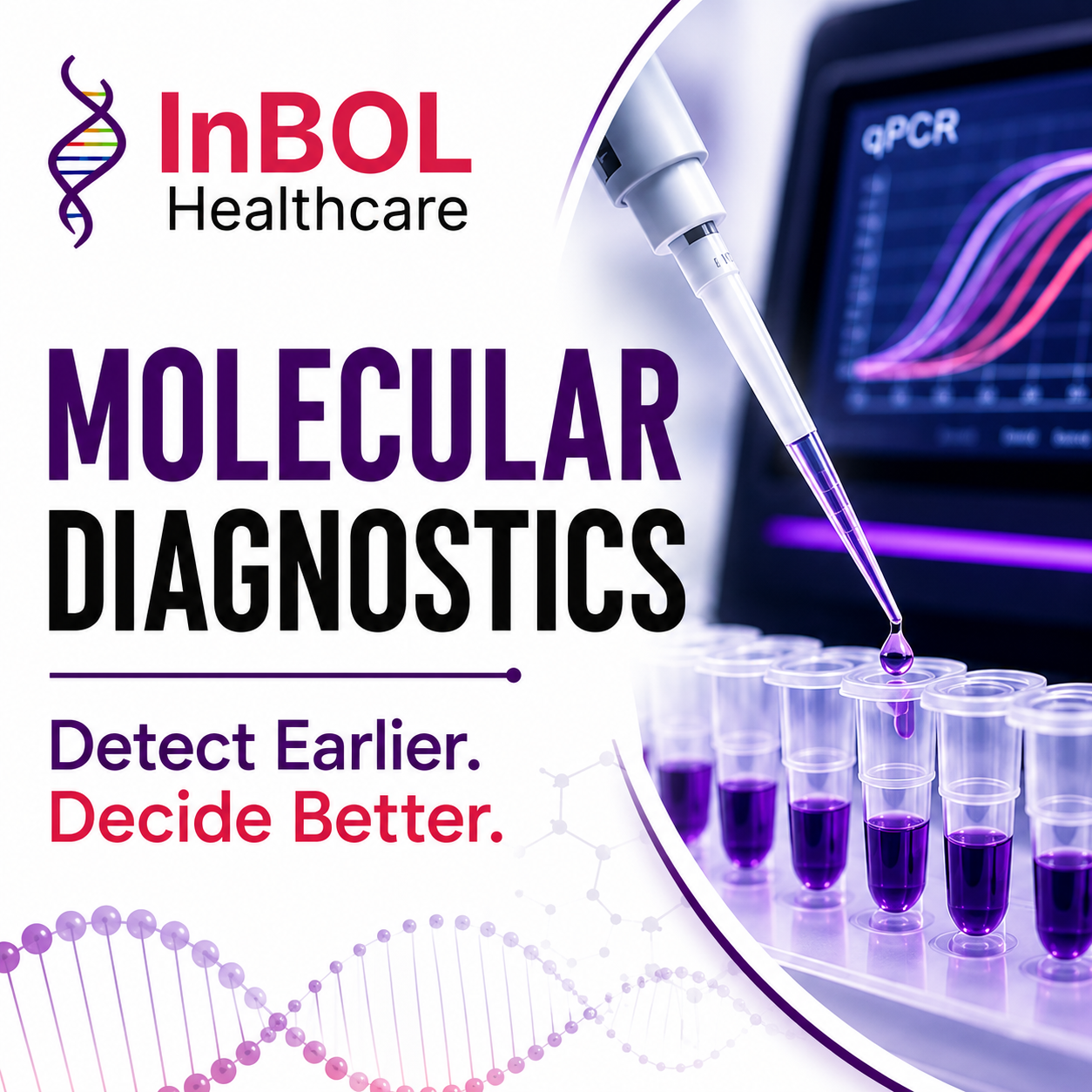
When clinicians, hospitals, and researchers search for molecular diagnostics services India, they are usually looking for faster clarity, better biological evidence, and more reliable disease detection. At InBol Healthcare Pvt. Ltd., we work with molecular workflows where a result is only useful when the right test, sample, protocol, and interpretation come together.
Disease detection is no longer limited to symptoms, imaging, microscopy, or culture-based methods. Molecular testing can identify DNA, RNA, mutations, pathogens, and biomarkers that conventional methods may miss or detect too late. Teams evaluating advanced testing can review InBOL’s diagnostic workflow and sequencing capabilities to understand how molecular methods support clinical and research-linked decision-making.
What Molecular Diagnostics Services India Include
Molecular diagnostics detect disease-related genetic or molecular signals from a patient sample. These methods are used when clinicians need more precise information than routine testing can provide, especially in cancer profiling, infectious disease identification, hereditary risk evaluation, and treatment-linked biomarker analysis.
A complete molecular diagnostic workflow usually includes:
- Sample collection and transport under suitable conditions
- DNA or RNA extraction
- PCR, RT-PCR, qPCR, or NGS-based testing
- Quality control checks at key stages
- Bioinformatics review where sequencing is involved
- Clear interpretation in the final report
The core value is not the instrument alone. A real diagnostic answer depends on the full chain: sample quality, assay selection, laboratory discipline, data review, and clinically usable reporting.
What Are Molecular Diagnostics?
Molecular diagnostics are laboratory methods used to detect disease-related changes at the DNA, RNA, or biomarker level.
In practical terms, a molecular test looks for a specific biological signal. That signal may come from a virus, bacteria, inherited variant, cancer-associated mutation, or treatment-relevant biomarker. This makes molecular testing valuable when a clinician needs to understand not only whether disease may be present, but what biological factor may be driving it.
For example, a routine test may suggest infection, while a molecular test can help identify the pathogen’s genetic material. In oncology, tissue analysis may confirm cancer, while molecular profiling may help identify biomarkers that influence treatment planning. The National Cancer Institute explains that biomarker testing for cancer treatment can help doctors assess genes, proteins, and other cancer-related markers when selecting treatment options.
At InBol Healthcare Pvt. Ltd., we treat molecular diagnostics as a workflow, not a single report. A technically advanced test can still fail to provide value if the sample is degraded, the wrong assay is selected, or the result is written in a way that does not support clinical interpretation.
PCR vs NGS Diagnostics
PCR and NGS are both molecular testing methods, but they answer different questions.
PCR is best suited when the target is known. If a clinician wants to detect a specific pathogen, mutation, or genetic sequence, PCR-based testing is usually fast, focused, and efficient. It works well when the question is narrow, such as “Is this target present?”
NGS, or next-generation sequencing, is useful when the question is broader. It can analyze many genes, regions, or microbial sequences at once. This makes it valuable for cancer panels, complex genomic profiling, pathogen surveillance, and cases where multiple possible targets need to be assessed together.
| Diagnostic Need | PCR Is Usually Better When | NGS Is Usually Better When |
| Target scope | One or a few known targets need testing | Multiple genes, variants, or organisms need analysis |
| Turnaround expectation | A focused answer is needed quickly | Deeper profiling is more useful than speed alone |
| Common use case | Known pathogen detection, RT-PCR, mutation-specific testing | Tumor profiling, variant analysis, microbial sequencing |
| Data complexity | Lower | Higher |
| Interpretation need | Usually direct | Requires bioinformatics and expert review |
Neither method is automatically superior. A common mistake is choosing NGS simply because it sounds more advanced. In many real workflows, a well-designed PCR assay gives a cleaner answer than sequencing. The reverse is also true: PCR may miss broader patterns that a sequencing-based approach can detect.
The better question is not “Which technology is best?” The better question is “Which method answers the clinical question with the right level of accuracy, speed, and interpretability?”
Benefits of Early Genomic Detection
Early genomic detection helps clinicians identify molecular changes before a disease becomes harder to diagnose, monitor, or manage.
This does not mean every patient needs broad genetic testing. It means the right molecular method should be used when the clinical question demands deeper biological clarity. The highest value appears when conventional testing is inconclusive, timing is sensitive, or treatment decisions depend on molecular evidence.
In real diagnostic workflows, the problem often begins before the machine is switched on. A delayed swab, poorly stored tissue block, low-yield extraction, or incomplete clinical history can reduce the usefulness of even an advanced assay. That is why laboratory process control matters as much as test selection.
Cancer Screening and Molecular Profiling
Cancer diagnosis and treatment planning increasingly depend on molecular information.
Histopathology, imaging, and clinical examination remain central. Molecular testing adds another layer by identifying mutations, gene expression patterns, or biomarkers that may influence therapy selection, prognosis, or monitoring.
For example, two patients may have the same cancer type on a pathology report, but their tumors may carry different molecular alterations. Those differences can influence whether targeted therapy, immunotherapy, or additional confirmatory testing is considered.
A reliable genomics testing laboratory should not simply list variants. The report should explain what was tested, what was detected, what was not detected, and where the limitations are. A variant with unclear clinical relevance should not be presented as a definitive treatment answer.
This careful interpretation is especially important in cancer-related molecular testing because clinical decisions usually depend on the full picture: biopsy findings, imaging, staging, patient history, and specialist review.
Infectious Disease Identification
In infectious disease detection, molecular methods can identify pathogen DNA or RNA directly from suitable samples.
PCR is commonly used when a specific infection is suspected. Sequencing can support broader pathogen investigation, outbreak analysis, and detection of genetic variation. The CDC describes advanced molecular detection as an approach that combines genomic sequencing, computing, and epidemiology to improve infectious disease investigation and public health response.
For hospitals, this can support faster decision-making. A timely molecular result may help guide isolation measures, antimicrobial planning, or further confirmatory testing. For researchers and public health teams, sequencing can reveal patterns that older methods may not show clearly.
Still, molecular results need clinical context. A detected signal does not always mean active disease. Contamination risk, sample timing, prior medication, pathogen load, and patient symptoms all affect interpretation.
When Should Clinicians Prefer Molecular Testing?
Clinicians should consider molecular testing when routine methods do not provide enough clarity or when treatment planning depends on a molecular-level answer.
In infectious disease, this may happen when culture is negative but suspicion remains high. It may also be useful when rapid pathogen identification is needed, or when resistance-related signals need further evaluation.
In oncology, molecular testing becomes relevant when biomarker information may influence therapy selection. For inherited conditions, genomic methods may help confirm suspected variants or clarify family-risk patterns. In research-linked clinical settings, sequencing services India are also being used to study disease mechanisms, mutation patterns, and molecular signatures in greater detail.
The key is to define the diagnostic question before choosing the test. “Do molecular testing” is too broad. “Detecting a known viral RNA target,” “profile actionable tumor variants,” or “evaluate a suspected inherited mutation” gives the laboratory a much clearer direction.
Why Hospitals Are Adopting Molecular Diagnostics
Hospitals are adopting molecular diagnostics because modern care increasingly needs faster, more specific biological evidence.
Conventional methods still matter. Microscopy, imaging, histopathology, serology, culture, and biochemical tests remain essential in many cases. Molecular methods are not replacing them across the board. They are strengthening the diagnostic pathway where traditional methods have limits.
From our experience, hospitals usually adopt molecular testing for three practical reasons.
First, some clinical decisions cannot wait for slower methods. Second, many treatment plans now require biomarker or mutation-level evidence. Third, clinicians want more confidence when symptoms, imaging, and routine reports do not align cleanly.
This is visible in oncology boards, infectious disease units, critical care settings, and research-driven hospital collaborations. The adoption is not only about buying instruments. It requires trained staff, validated protocols, proper sample logistics, reporting discipline, and a communication loop between the laboratory and the requesting clinician.
A molecular biology laboratory services provider should understand that the report is not the endpoint. The endpoint is a better clinical or research decision.
What Makes a Molecular Diagnostic Report Useful?
A molecular diagnostic report is useful when it reduces uncertainty for the clinician.
For PCR-based testing, the report should clearly mention the target, sample type, method, control status, result interpretation, and limitations. For RT-PCR or qPCR workflows, Ct value interpretation should be handled carefully and only within the validated context of the assay.
For NGS-based testing, the report should explain sequencing quality, relevant variants or organisms, coverage limitations, and interpretation confidence. Bioinformatics output should not be dumped into the report without context. Clinicians need meaningful interpretation, not raw complexity.
At InBol Healthcare Pvt. Ltd., we look closely at three practical questions during molecular workflow review: Is the sample suitable? Is the method appropriate? Is the result understandable for the person who requested it?
These questions prevent avoidable confusion. They also help protect the integrity of the final interpretation.
Choosing a Reliable Genomics Testing Laboratory
A reliable laboratory is defined by process control, not just equipment.
Hospitals, clinicians, and researchers should evaluate how the lab handles sample acceptance, nucleic acid extraction, contamination prevention, assay validation, quality control, sequencing review, data protection, and final reporting.
A dependable laboratory should also be honest about test limitations. PCR may miss targets outside the assay design. NGS requires sufficient DNA or RNA quality. Low-quality samples can reduce confidence. Some findings may need confirmation, repeat testing, or clinical correlation.
This transparency matters because molecular testing can influence serious decisions. Overstated reporting creates risk. Under-explained reporting creates confusion. The right laboratory partner should do neither.
For clinical and research teams, the best diagnostic partner is one that can connect molecular science with real-world decision-making.
Practical Checklist Before Sending a Molecular Sample
Before sending a sample, define the diagnostic question clearly. This single step improves test selection and reduces unnecessary testing.
The requesting team should confirm the sample type, storage condition, transport timeline, patient context, and expected reporting need. A poorly preserved tissue sample, delayed swab, insufficient blood volume, or missing clinical information can reduce the value of the entire workflow.
A request form should include enough context to support interpretation. “Fever” is too broad. “Persistent fever with negative culture and suspected viral etiology” is more useful. “Lung cancer sample” is less useful than “NSCLC tissue sample for mutation profiling.”
Small details often decide whether a molecular report becomes clinically helpful or only technically complete.
FAQs
What are molecular diagnostics used for when routine tests do not give a clear answer?
Molecular diagnostics are used to detect DNA, RNA, pathogens, mutations, or biomarkers when routine tests do not provide enough biological detail. The test must match the suspected condition, sample type, and clinical question to produce a useful result. Clinicians can review InBOL’s service page for deeper details on available molecular testing workflows.
Is NGS better than traditional testing for every disease detection case?
NGS is not better for every case because it is most useful when broad genomic profiling or multi-target analysis is needed. PCR or other targeted methods may be faster and more cost-effective when the diagnostic question involves one known pathogen or mutation. A practical approach is to use PCR for focused detection and NGS for complex profiling or unresolved cases.
How should a hospital choose between PCR and NGS diagnostics?
A hospital should choose PCR when the target is known and quick detection is needed, and choose NGS when broader molecular information is required. The decision depends on sample quality, urgency, budget, disease type, and the depth of interpretation needed. The safest first step is to define the diagnostic question before selecting the platform.
What makes a genomics testing laboratory reliable for clinical samples?
A reliable genomics testing laboratory follows validated protocols, contamination control, quality checks, secure data handling, and structured interpretation. Poor sample quality or incomplete clinical information can reduce the usefulness of even advanced molecular testing. Hospitals should confirm the lab’s QC process, reporting standards, and communication workflow before sending critical samples.
Practical Wrap-Up
Molecular diagnostics are changing disease detection because they help clinicians move from broad suspicion to more precise biological evidence. PCR, NGS, and related molecular methods are most useful when the test is selected carefully, the sample is handled correctly, and the result is interpreted in clinical context.
For hospitals, researchers, and clinicians, the next step is not to choose the most advanced test by default. The better approach is to ask the right diagnostic question, select the right method, and work with a laboratory team that understands both molecular science and practical reporting.
For teams in Kolkata and Eastern India evaluating molecular testing support, InBol Healthcare Pvt. Ltd. serves clinical and research-linked users from its Kalighat location near Metro Gate No. 2, Nakuleswar Bhattacharjee Lane. Local teams can visit InBol Healthcare Pvt. Ltd. on Google Maps to review the physical business profile and plan a consultation.